Property owners and facility managers across Southwest Florida who are comparing flat roofing systems frequently end up at the TPO versus EPDM question. Both are single-ply membrane systems. Both are widely used in commercial and low-slope residential applications. They perform differently in Florida’s climate, cost differently, and have different long-term maintenance profiles. Here are the seven differences that actually matter for making the right decision in the Southwest Florida market.
1. Heat Performance — TPO Wins in Florida
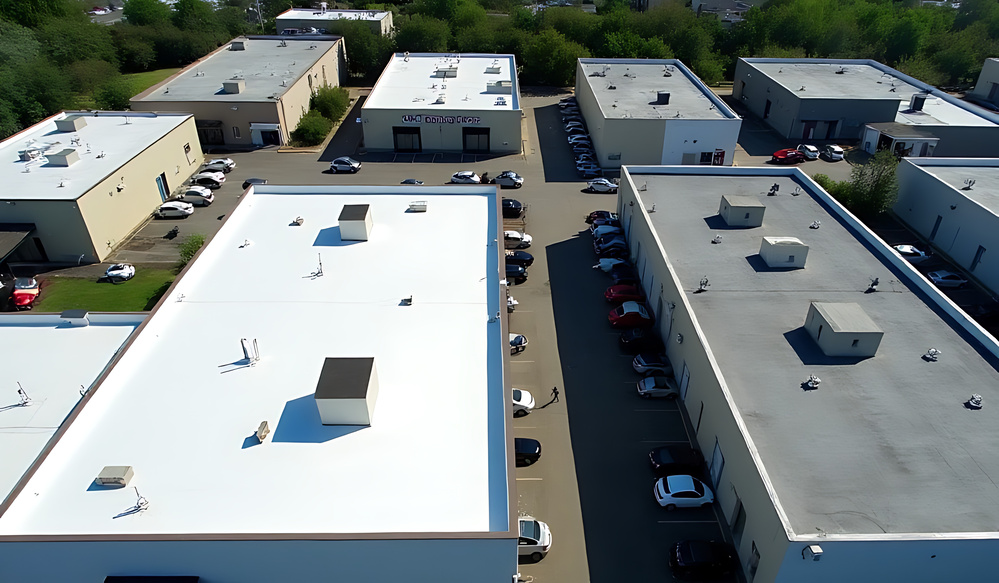
TPO’s defining advantage for Florida applications is its reflective white surface. In Southwest Florida’s climate, where summers regularly exceed 90 degrees and flat roofs absorb direct solar radiation for most of the year, the difference between a reflective white membrane and EPDM’s traditional black surface is significant. Studies measuring rooftop surface temperatures on comparable days show black EPDM surfaces running 50 to 90 degrees hotter than white TPO in direct sun. That difference directly affects the cooling load on the building below.
White EPDM is available as an alternative, but most EPDM installed in the field is black, and the reflectivity benefit of white EPDM degrades faster than TPO’s factory-embedded reflective coating.
2. Seam Construction — TPO Has the Advantage
TPO seams are heat-welded, meaning the two membrane sections are literally fused together under controlled heat. The welded seam is as strong as the membrane itself when done correctly. EPDM seams rely on adhesive tape or liquid-applied adhesive bonding. In Florida’s heat, adhesive-bonded EPDM seams experience more thermal expansion and contraction stress than in northern markets, and adhesive failure is a more common cause of EPDM leaks here than in cooler climates.
3. Lifespan in Southwest Florida
In Southwest Florida’s UV and heat environment, properly installed 60-mil TPO typically lasts 15 to 25 years. Properly installed EPDM lasts 15 to 25 years as well in good conditions. The key qualifier for both is ‘properly installed’ — seam quality and flashing detail are the primary determinants of actual lifespan. For TPO, 60-mil membrane is strongly preferred over 45-mil in Florida’s UV intensity. 45-mil TPO reaches end of life faster here than in northern markets.
4. Cost Comparison
For a typical commercial building in Southwest Florida, current market pricing:
- TPO installation: $8 to $14 per square foot depending on thickness, penetration count, and access conditions.
- EPDM installation: $7 to $13 per square foot.
The cost difference is moderate. For most new installations, the energy savings from TPO’s reflectivity often offset the marginal cost premium within a few years in Florida’s climate.
5. Flexibility and Penetration Handling — EPDM Wins Here
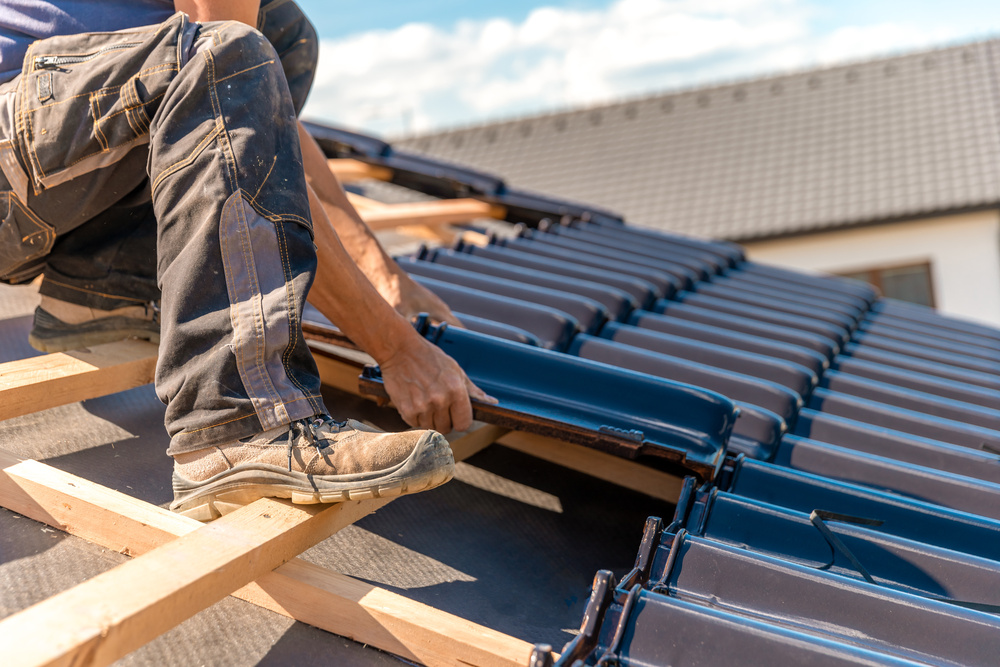
EPDM is a rubber membrane with significantly more flexibility than TPO, which is a thermoplastic. For roofs with complex geometry, many penetrations, or unusual configurations, EPDM’s flexibility makes it easier to work with detailed conditions. This is the primary scenario where EPDM is still the preferred choice for experienced commercial roofing contractors: applications where the TPO seaming process is difficult to execute correctly around complex details.
6. Repair Characteristics
TPO repairs require heat welding equipment for permanent seam repairs, which means quick field patches are possible but lasting repairs need the right equipment. EPDM repairs can be made with adhesive patch materials available in the field without specialized equipment, which makes minor repair work faster for maintenance teams. Both systems require periodic inspections and prompt attention to any seam or flashing deterioration.
7. Availability and Contractor Experience in Southwest Florida
Both TPO and EPDM are well-represented in the Southwest Florida commercial roofing market. Galloway Roofing installs both systems and can assess which is more appropriate for a specific building based on its configuration, cooling load requirements, and the property owner’s maintenance preferences.
Frequently Asked Questions: TPO vs EPDM in Florida
Which is better for flat roofs in Southwest Florida — TPO or EPDM?
For most flat roof applications in Southwest Florida, TPO is the better choice. The reflective white surface reduces cooling loads in Florida’s heat, and heat-welded seams are more durable than adhesive-bonded EPDM in high-UV environments. EPDM remains appropriate for applications with complex penetrations where TPO seaming is more difficult.
How long does TPO last in Florida?
60-mil TPO in Southwest Florida typically lasts 15 to 25 years when properly installed and maintained. The intense UV environment here shortens lifespan compared to northern markets, which is why 60-mil is recommended over 45-mil for Florida commercial applications.
Does Galloway Roofing install TPO and EPDM in Southwest Florida?
Yes. Galloway Roofing installs TPO, EPDM, and silicone roof coating systems for commercial properties across Southwest Florida. Free site assessments and estimates are available. Call 941-697-3737 to schedule.